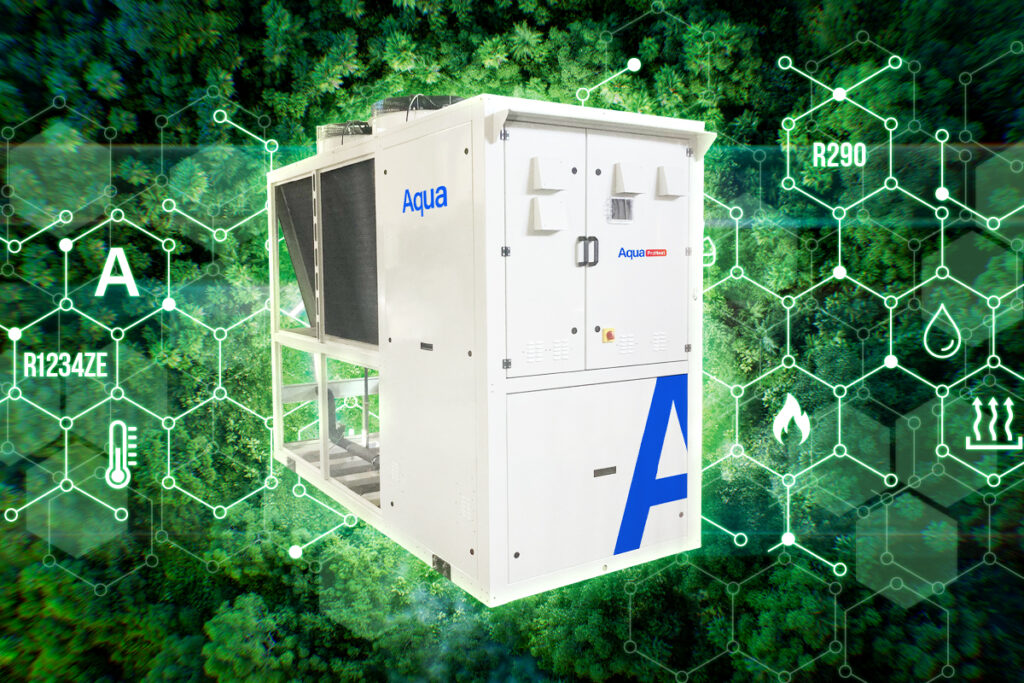
Heat pumps have become increasingly popular in residential and commercial settings over recent years. The UK Government introduced the Boiler Upgrade Scheme to encourage property owners to replace their gas boiler with heat pump technology. Plus, growing concerns over fossil fuels and their environmental impact, rising energy costs and global politics, are making sustainable alternatives to gas more and more attractive.
However, what are the options when it comes to the industrial sector? In this article Aqua Director, Simon Davis, gives his thoughts on how heat pumps are emerging as a transformative solution for industrial applications.
Heat pumps & waste heat recovery
“The focus within the temperature control industry has centred around energy efficiency, helping businesses to reduce both their operating costs and carbon footprint. Legislation around fluorinated greenhouses gases has encouraged manufacturers to embrace greener refrigerants and initiatives such as free cooling have played an important role in reducing energy consumption. The latter centres around how effective a process cooling system is at removing the heat from the process, which in essence is great. But the heat that’s removed is normally wasted. What if this energy was recovered and recycled? That’s where things get interesting!
High grade hot water up to 120°C
“Traditionally, the temperatures that heat pumps could achieve were limited to somewhere between 55°C and 65°C, which wasn’t sufficient for industrial applications. However, with more recent R&D and advances in technology, it’s now possible for a water to water heat pump to achieve 120°C, in an external ambient as low as -15°C. So, why not take your waste heat, recycle it into high grade hot water and repurpose it elsewhere within your manufacturing process? You’ve already paid to create this energy, so if it’s recovered and re-used, then effectively it’s free, drastically reducing your operating costs.
“The heat pump basically replaces your chiller & boiler. You’ve got one piece of equipment to invest in rather than two. Plus, if space is restricted, you’ve got one less piece of kit to house.
“Other advantages of total energy recovery are that you eliminate your reliance on gas. There’s been political tension over global gas supply for some time, plus it’s a natural resource, so why deplete it if there’s an alternative?
Low GWP + natural refrigerant operation
“On the subject of natural resources, it’s worth noting that industrial heat pumps operate on a range of low GWP refrigerants, including natural options such as R290 (propane), R600a (Isobutane) and R744 (CO2).
“One question I’m often asked by customer is “if I recycle the heat from my process, what happens at the start and end when I have either no heat or too much heat?” Great question, but that’s actually pretty simple to overcome with the right type of heat pump technology. Really, if you use heat within your process, then you need to seriously consider implementing a heat pump. They offer a highly sustainable alternative to traditional heating & cooling systems and ROI is really impressive.
Benefits
Here’s a summary of just some of the immediate benefits:
- Achieve nett zero & environmental goals quickly
- Significant reduction in carbon footprint
- Co-efficient of Performance (COP) as high as 5
- Swift ROI on initial equipment costs
- Future proofs your business by removing reliance on gas
- Lower maintenance costs
- Smaller footprint
“The potential for heat pumps is huge, across a range of industry sectors, including food processing, chemical manufacturing and plastics processing. Today’s technology is extremely versatile, cost effective and has the potential to revolutionise the way you think about energy management in the future.”
If you’d like to discover more about heat pumps and achieving waste energy recovery, contact the team on 0330 828 9116. We’d love to help!